DHS Requires Non-U.S. Travelers to Be Fully Vaccinated
The Department of Homeland Security laid out a phased vaccination mandate for foreign nationals entering the country, covering air travel first and land and ferry crossings roughly two and a half months later.
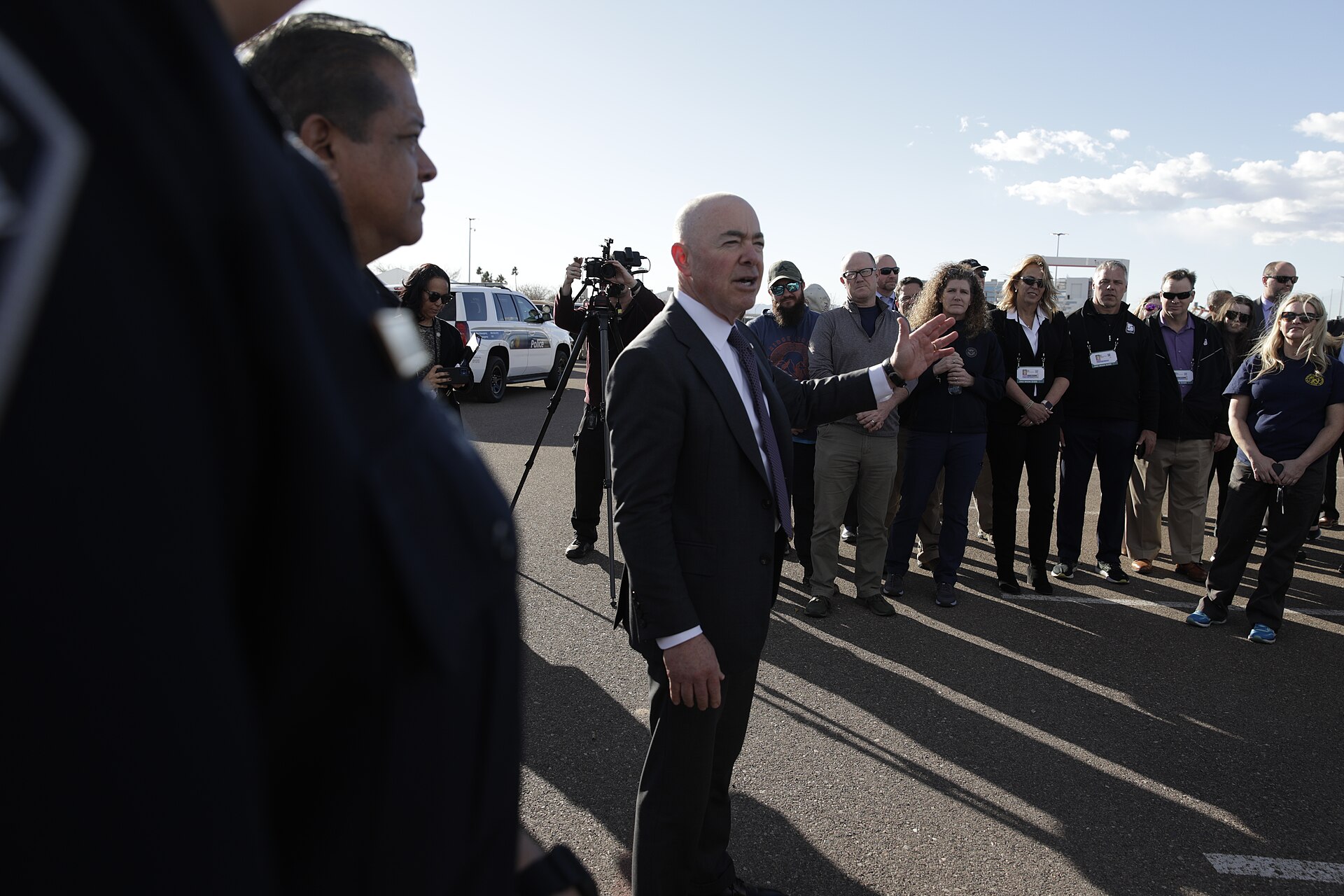
The Department of Homeland Security on October 29, 2021 released details of a new requirement that non-U.S. citizens be fully vaccinated against COVID-19 to enter the country, extending a rule already set for air travelers to the land border and ferry crossings that make up the bulk of daily cross-border traffic with Canada and Mexico. The land and ferry requirement takes effect January 22, 2022, DHS said, following a separate air travel vaccination requirement for noncitizen nonimmigrants that began November 8, 2021, according to a Transportation Security Administration statement covering that piece of the policy.
The rules stem from President Biden's Proclamation 10294, "Advancing the Safe Resumption of Global Travel During the COVID-19 Pandemic," signed October 25, 2021, and from related CDC orders governing entry at U.S. ports. Fox Business and NBC San Diego both reported that Homeland Security Secretary Alejandro Mayorkas framed the policy as balancing public health with commerce, saying the measures "reflect the Biden-Harris Administration's commitment to protecting public health while safely facilitating" cross-border trade and travel.
Exactly how enforcement will work at land crossings, and how strictly agents will verify vaccination status against various international vaccine records, was less settled in the reporting available. Coverage did not specify penalties for noncitizens who arrive at a land port without qualifying proof, nor did it detail how the requirement interacts with asylum seekers or others whose entry is governed separately by CDC expulsion authority — an ambiguity Fox Business's account flagged by noting that those "entering irregularly" remain subject to separate CDC orders rather than this vaccination rule.
Two timelines, two modes of travel
The policy rolled out in stages by mode of travel rather than all at once. Air travel came first: noncitizen nonimmigrants flying into the United States were required to be fully vaccinated starting November 8, 2021, per the TSA statement describing that requirement, and separately to show a negative COVID-19 test taken no more than three days before departure, regardless of vaccination status, for travelers age 2 and up.
Land ports of entry and ferry terminals followed on a longer runway. Beginning January 22, 2022, DHS said, all inbound noncitizen travelers — whether crossing for essential reasons like work or school, or nonessential reasons like tourism — would need to be fully vaccinated to enter. Both Fox Business and NBC San Diego reported that, unlike the air rule, no COVID-19 test would be required for land or ferry entry. U.S. citizens, lawful permanent residents and U.S. nationals were excluded from the mandate entirely, the reporting noted.
What travelers had to show
For land and ferry crossings, the requirement was described as a combination of a verbal attestation and physical proof. According to NBC San Diego's account of the DHS details, travelers would need to verbally confirm their vaccination status to a Customs and Border Protection officer, present proof of vaccination with a CDC-accepted vaccine — the reporting listed Pfizer, Moderna, Johnson & Johnson, AstraZeneca and Covaxin among those accepted — and carry a valid WHTI-compliant travel document, such as a passport or trusted-traveler card, on top of standard border inspection. The requirement to vaccinate applied on top of, not instead of, the existing document checks CBP already performed.
The border-communities backdrop
The land and ferry announcement carried particular weight along the U.S.-Canada and U.S.-Mexico borders, where nonessential travel restrictions tied to the pandemic had already been in place for well over a year by the time DHS detailed the vaccination rule. Coverage from outlets close to the border, including NBC San Diego, framed the January 22 date as the moment those long-standing restrictions would effectively convert into a vaccination requirement rather than a blanket ban — reopening nonessential travel for those who could show proof of a CDC-accepted vaccine, while closing the door to nonessential entry for those who could not.
US In News compiled this archived account from contemporaneous coverage by Fox Business and NBC San Diego. It restores a story originally published on this site in October 2021; figures are as reported at the time.